

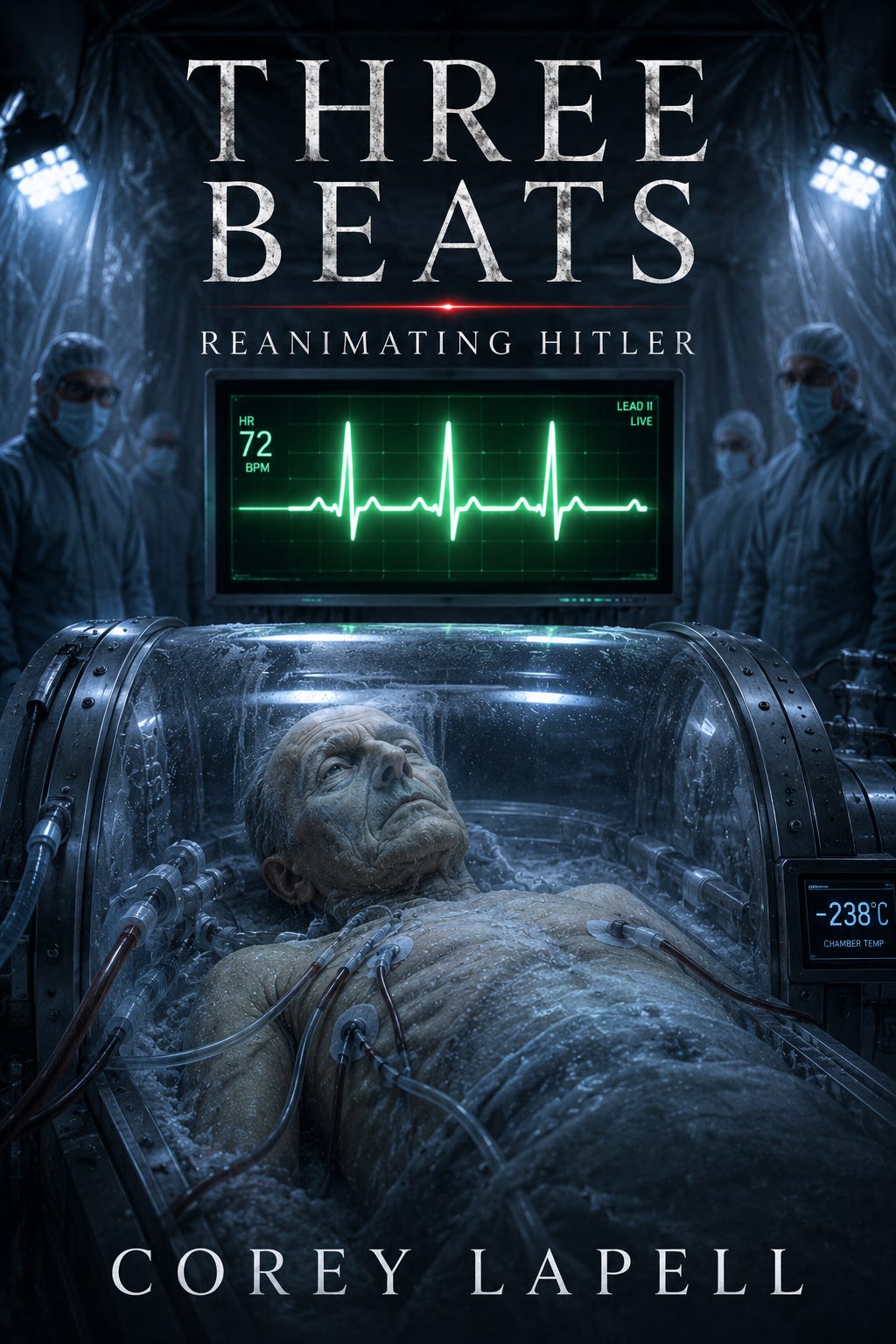
Three beats. It doesn’t sound like much. But it can be enough to change a life.
The research team knew it wasn’t going to work. Even when they discovered Hitler’s cryogenically preserved remains in a secret vault in Bariloche, they knew they would not be able to revive him.
The project was supposed to be secretive, but how secretive can something as momentous as that remain? Eighty years after his death, a body unexpectedly recovered, preserved by a technology we have yet to perfect.
It hit the news like a bombshell, sparking mass protests. Most were against any attempt to revive the Nazi leader, but there were also those who demanded that researchers try to bring him back to the land of the living. Strangely, the two groups most vocally in support of reviving Hitler were the Neo-Nazis and certain Jewish justice groups. Strange bedfellows indeed.
The Neo-Nazis obviously fancied a second coming of the Third Reich and heralded the discovery of Hitler as something akin to the resurrection of Christ the Saviour after his crucifixion. The Jews, on the other hand, insisted on his revival because only then could they bring the genocidal war criminal, who had ducked the Nuremberg trials by hiding out in South America, to justice.
What none of the groups for or against the resurrection of Hitler grasped was just how antiquated the cryogenic technology used to preserve the Nazi leader was. The team of specialists brought in to carry out the procedure—it had quietly been agreed that an attempt to revive Hitler should be made, not for any of the reasons stated above but purely for science as it had never been done before—knew the odds were poor. In fact, preliminary tissue samples indicated that despite the cryogenic freezing, some tissue putrefaction had already set in. If they succeeded in reviving Hitler, it would be in a failing body.
Despite having life support systems at the ready, prospects looked poor. But there would be something to learn no matter how it turned out. Even understanding how cryogenic systems could fail would advance our limited knowledge of this science in its infancy. And after all, who apart from Nazi sympathizers was going to shed a tear if the attempt to revive the most reviled man in history failed?
The trick in cryogenics is less about the freezing of live tissue, which is almost instant; it is in restoring that tissue to normal temperatures safely. Unlike more robust organisms like the tardigrade, human cells cannot survive the wide range of temperatures between flash-frozen and 98.6 degrees Fahrenheit.
Below 55.8 or above 115.7, life pretty much stops for us. So how do you get from the cryogenic chamber temperature of -238 degrees to the survivable, albeit hypothermic 55.8 without killing the subject in the process?
The researchers had tubes hooked up to every major artery in the frozen Führer’s body, electric heating pads surrounding his frigid flesh and a high-powered defibrillator set up, all inside an oxygenated tent. At a signal, the heating pads switched on, warm blood transfusion began pumping into the tubes connected to Hitler’s icy arteries and the defib machine, programmed to respond to Hitler’s core temperature, charged itself preparing for the moment when his rapidly climbing core temperature hit 55.8 degrees.
“Clear,” the AI warned, and the medical team stepped back as the charge jolted the already rigid body, rendering it slightly more rigid than before.
Nothing.
The defibrillator resumed charging, the monitors charting Hitler’s rising temperature: 60.1, 62.8, 64.2.
“Clear.”
This time the body, a little less frosty, a little more pliable, gave a twitch as the charge ran through it.
“Charging,” the defib switched back to its power-up mode.
66.3, 67.1, 67.9.
“Clear.”
And this time Hitler did more than twitch. His spine bridged off the bed in an electrified arch. He collapsed back onto the heating pads as before, but then the heart monitor gave a beep. The medical team gave a shout.
One beep. A second beep. And then a third.
We held our collective breath, barely able to believe what the heart monitor was showing us. But what happened next went beyond all expectations.
As we watched in horrified fascination, Hitler’s eyelids lifted as if they weighed ten pounds apiece. His deep brown, malevolent eyes scanned left-to-right taking in the masked medical professionals surrounding his bedside. After eighty years of cryogenic freezing, the Führer was looking at us.
That was what sparked the controversy. The opening of the Führer’s eyes made headlines and stirred renewed debate about ethics, cryogenics, and the nature of consciousness itself. It stimulated arguments about whether or not the Führer had achieved a state of awareness.
Not among the research team, of course. Dr. Chiu and his team, professionals all, maintained that it had been nothing more than a muscular reflex triggered by the charge from the defibrillator, a galvanic response like that elicited by attaching electrodes to the limbs of dead frogs, rather than a sign of life or, even more unlikely, consciousness.
But many among the attending nurses and research assistants were less disposed to discount the movements of Hitler’s face in that brief three heart beat moment.
“He looked right at me,” one insisted.
“It was like he was trying to say something,” agreed another.
“He was alive; he saw us!”
Dr. Chiu and the other senior researchers did not include these fanciful sentiments in their reports and laboured to squash such conjectures whenever interviewers raised them, but those of us who had been there in that oxygenated tent the moment Hitler awoke for three brief heart beats knew what we had witnessed.
I was standing right there beside the EKG when his eyes pinned me and I felt the full weight of that man’s monstrous charisma. The breath caught in my throat as I watched his mouth open with a dry gasp like a landed carp.
And then his face caved in.
A few of the research assistants screamed. It was like watching a film of organic decomposition in stop-motion. The flesh just sort of melted off Hitler’s face and the rest of his body too. Tubes fell free of collapsing veins, pumping warmed blood and plasma over the white sheets like a gory schlock horror picture. Larger bones like Hitler’s skull and pelvis collapsed under the weight of the putrefying flesh like a jack-o’-lantern left out six weeks past Halloween.
Hewn of sterner stuff, Dr. Chiu, the lead researcher, simply said, “That was unexpected.”
Unexpected? It was the stuff of nightmares. And yet three beats were enough to change the trajectory of Dr. Chiu’s career and revive the popularity of the field of cryogenics.
Three beats. It doesn’t sound like much. But it’s enough to change a life. Three beats were the miracle Dr. Chiu et al. needed to secure private funding for their revolutionary start-up. Debate as you will the import or lack thereof underlying Hitler’s last glare and his final gasp, but those three beats of his heart recorded by the EKG verified beyond a doubt that, conscious or not, for one brief instant, the cryogenically preserved leader of the Third Reich had, like Christ himself, risen from the dead.
And that was enough to fund further research in our field. God help us all.